
AI Is Not the Value Proposition — Five Signals From the Road
After five states and dozens of conversations with farmers, agribusiness leaders, processors and food companies, the Purdue DIAL Ventures team kept hearing the same frictions. This piece covers five signals from the road: the gap between data and confident decisions, the manual "last mile," systems that don't connect, the economics and risk behind every choice, and the trust that agriculture still runs on. The takeaway is simple. Don't start with AI. Start with a problem worth solving.
I grew up on a farm. And like a lot of farm kids, I went off to school to become an English professor — two years at a liberal arts college studying English literature and secondary education. On paper, that makes no sense at all.
I'd argue they were two of the most valuable years of my education because I spent them around people who didn't look, think or talk like me. Twenty-five years in agriculture and food later, that's still the part of this work I trust most: sitting with people whose experience isn't mine, listening carefully and asking better questions.
I recently hit the road with our Purdue DIAL Ventures Innovation Fellows — five states and dozens of conversations with farmers, agribusiness leaders, equipment manufacturers, cooperatives, processors and food companies. Several people have asked what we actually heard. Fair question.
This studio cycle is focused broadly on AI and digital because that's where much of the industry's attention is right now — and where relatively little is settled. Nearly everyone I talk with is spending time or money on AI. Far fewer can clearly articulate what it has returned. I've heard some version of we know we need to be doing this; we're just not sure what we're doing from senior people inside large, sophisticated organizations. I don't say that as criticism. It's early.
In some ways, this feels like the early days of the internet. Every industry eventually had to work out what it meant to operate a business with it. We're there again.
But here's the distinction I keep coming back to: AI is not the value proposition.
AI is an enabling technology. The value proposition is a better decision, a more productive workflow, a handoff that no longer breaks, capital or labor put to better use, or a trusted relationship made stronger.
That's why we went out to listen rather than starting with something we wanted to build. Technology is moving extraordinarily fast, but the opportunity isn't the technology itself. The opportunity is an important problem that technology can now solve differently.
Five Signals From the Road
A signal isn't a business idea, and it certainly isn't proof. It's repeated evidence that something important may be happening beneath the surface. When we hear the same friction repeatedly, in different businesses and different parts of the value chain, it's something worth exploring.
Then the real work begins: combining those observations with deeper research and analytics, testing them with more industry leaders, and quantifying whether the problem is significant enough — and addressable enough — to build a business around.
.jpg)
Five signals kept surfacing.
1. We have plenty of data. Turning it into timely, confident decisions is still hard.
Agriculture has invested substantially in sensing, precision agriculture, ERP systems, market information, agronomic platforms, equipment data and, increasingly, AI. Yet the person ultimately responsible for the decision is still frequently assembling information from multiple places and applying experience and judgment.
"I'll spend 20 minutes pulling this report from AI, and I'm like, that's just wrong… I could have been down the road by now."
Small example, larger implication: technology that creates another output without improving the decision may actually add friction.
An Iowa row-crop farmer with roughly 50,000 bushels of corn still unpriced described weighing market price, basis, transportation, storage, cash needs and timing:
"There's no right or wrong answer. It's just… what's my circumstance of the day and the time that I've got and the needs that I need filled right now."
Asked what greater certainty around profitability would be worth, he answered:
"It would be massive… certainty, profitability. If you can lock in those things, it is extremely valuable."
That gets much closer to the opportunity. The next significant digital opportunity may not be another source of information. It may be the decision layer between information and action — bringing fragmented inputs together, reducing uncertainty and making it easier for a person to act with confidence.
AI could be enormously important here. But AI isn't what creates the value. The better decision does.
I use an AI assistant a bit like I use a spreadsheet — a tool of real value, with its own purposes. That's less exciting than much of what you'll read about AI, but closer to how the people we sat with actually think about it.
So we're asking: Where are people spending real time assembling information before deciding? Where do they distrust what their systems tell them? Which decisions are frequent, expensive or consequential enough that greater confidence has measurable economic value?
2. Even sophisticated operations have a surprisingly manual "last mile."
Some of the most useful moments came when we stopped asking executives about "digital transformation" and instead asked operators to walk us through exactly how the work gets done. That's where the manual steps started showing up.
At a sophisticated seed company, a conversation about inventory moved through supply planning, demand forecasting and a new ERP system — and ended here:
"We're actually going out and we're physically counting how many kernels are on each ear."
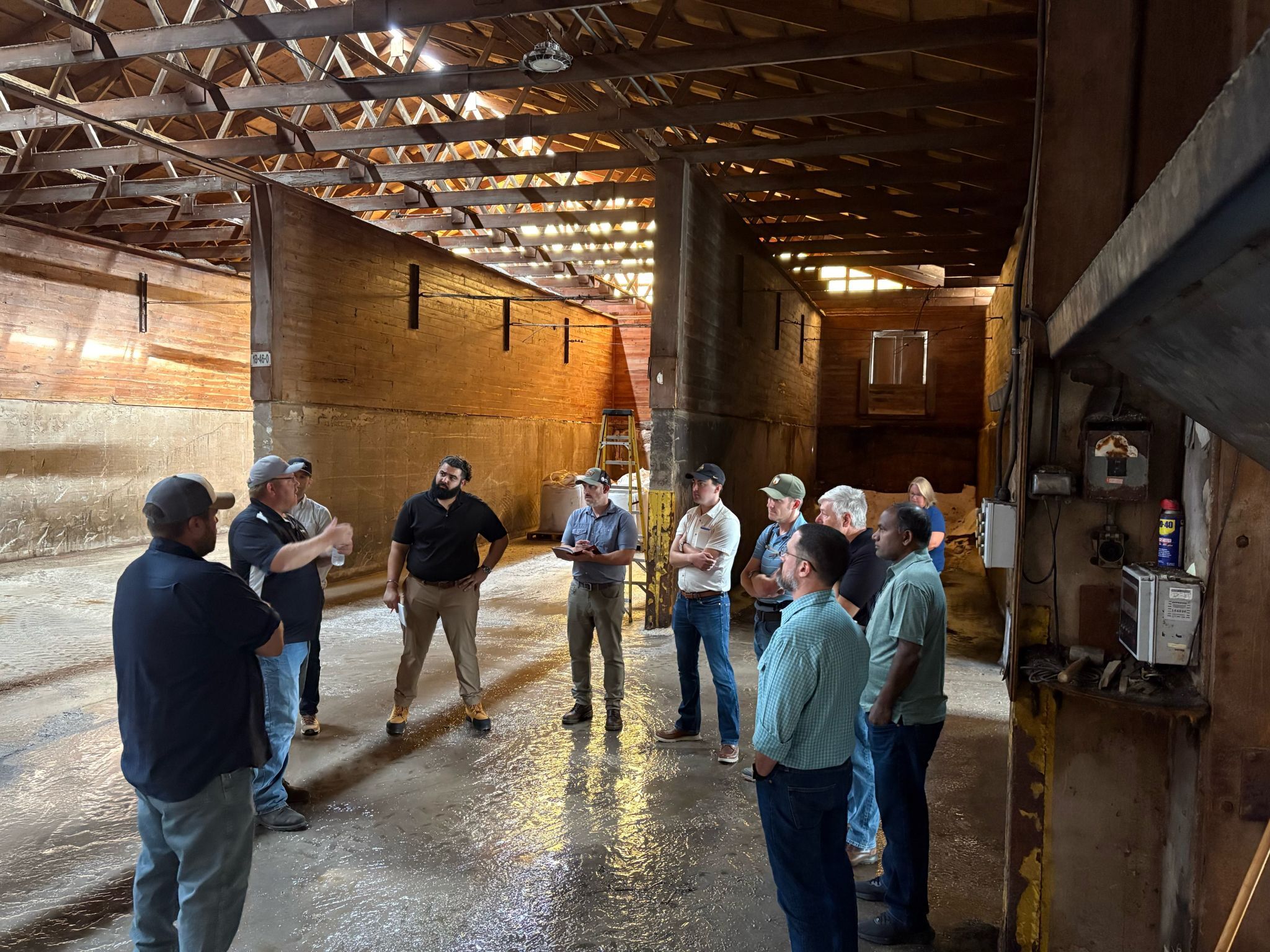
At a large agricultural retailer, a conversation about fertilizer inventory revealed a deeply physical process — barge delivery, trucking, conveyors, storage, blending, scales, gates and field delivery — with one person personally coordinating ordering, logistics and truck scheduling.
And the system works. It moves product, serves customers and does it reliably every day, at scale. The people running it aren't behind. The opportunity is understanding where unnecessary friction remains.
Gurkern Sufi, one of our Innovation Fellows, described the value of getting beyond what is advertised as a solution and seeing what is actually used in practice. His takeaway was simple: getting in front of people and letting them teach us about their business revealed gaps that were otherwise difficult to see.
Letting them teach us about their business. That's the method.
The last mile can be a spreadsheet, a clipboard, a phone call, a physical count, someone re-entering information or one experienced employee who simply knows how everything works. Individually, these things can look insignificant. Repeated thousands of times, they can represent meaningful labor cost, error, delay, working capital, safety exposure and lost productivity.
The existence of an enterprise platform does not necessarily mean the underlying workflow has been digitized. So when someone tells us, "our system handles that," one of the most useful questions we can ask is: Show me what happens next.
3. Technology exists, but systems, data and workflows often don't connect.
This may be the strongest structural signal of the five. Agriculture doesn't lack software. Individual systems often do their jobs quite well. The trouble shows up when data, work or decisions have to cross a boundary — between platforms, machines, companies, departments or people.
"We need to get to the point that there's no paper… The operator pulls in the field, and he can see on his monitor he is in the right field. We need to get there. We're not there yet."
Asked why, the answer was straightforward: many different systems, and they don't communicate the same way. Another participant put it this way:
"This is that interoperability problem."
We also saw the opposite: a farmer placing an offer through a third-party application, the information flowing into a grain merchandiser's systems and the contract being created automatically. That contrast shows both the friction and what becomes possible when the handoff disappears.
Agriculture may not need another standalone platform nearly as much as it needs connective tissue — machine to agronomist, farmer to retailer, field to office, physical product to digital record, data to decision. Every handoff is a candidate for latency, duplicate work, information loss and error.
But “solve interoperability” is not a useful starting point for building a company. It's too large. The better question is: Which specific handoff matters enough to fix?
Where does information leave one system and enter another? What happens at that handoff? What breaks? And what is the economic value of making it work? The system-level problem may be interoperability. The venture opportunity may be much smaller — and much more valuable.
4. Economics, risk and uncertainty ultimately drive behavior.
A lot of conversations that started out being about technology turned out to be about economics. Nobody adopts technology in a vacuum. Business leaders and producers are allocating scarce capital, time, people and management attention against commodity prices, weather, interest rates, inventory, labor, equipment, volatility and margin. Technology competes against every other use of those resources.
"I should have sold it in the spring. That's in my head. I should have sold it. I could have had that cash."
And there's a dimension that doesn't show up neatly in a spreadsheet:
"It sounds easy, but the emotions and the reality of it make it incredibly hard."
Succession surfaced the same forces on a much longer horizon. One farmer described the choice of continuing to invest capital in an operation hoping another generation returns — or deploying it elsewhere. Different problem. Same underlying forces: capital, uncertainty, risk, time and decisions that are difficult to reverse.
That's why we need to think differently about technology adoption. The question isn't simply whether the technology works. It's whether the economic value justifies changing behavior.
Does it reduce enough uncertainty? Protect enough margin? Release enough working capital? Save enough labor? Reduce enough risk? And can someone see the return clearly and quickly enough to justify doing something differently?
The best opportunities may be those where technology changes the economics of a decision, not simply the experience of completing a task. That means quantifying the cost of inaction, uncertainty, capital at risk, labor consumed — and the economic value of greater confidence.
5. Agriculture runs on relationships. Technology must strengthen, not compromise, that trust.
The agrifood system is sophisticated, increasingly digital and highly technical. It also still runs on trusted relationships built over years.
At one agricultural retailer, an operator described how differently individual farmers want to be served. One wants a price, fast. Another might spend two hours talking and land, in effect, on: I already know I'm doing business with you, because I know you'll take care of me.
That isn't inefficiency. The relationship is part of the product.
The same thing came through in broader conversations about agricultural retail — real appetite for digitization, paired with concern about damaging the relationships the business model depends on. Efficiency alone may not drive adoption. A solution that removes an interaction customers value could destroy value while looking more efficient on paper.
There's a data dimension to the same trust question. Producers know they're generating enormous amounts of data, but they're frequently not sure where it lives, who is doing what with it, or whether it is working for them or costing them. That isn't solved with a better interface. It is solved by demonstrating a direct return to the producer's business and being straightforward about what happens to their information.
One of the more compelling opportunities may therefore be technology that makes trusted people better at the relationship: giving an agronomist better insight before a farm visit, helping a salesperson retain important context, or eliminating administrative work so an advisor can spend more time advising.
Relationships aren't necessarily something technology should replace. They may be something technology should amplify.
.jpg)
So, what happens now?
None of these five observations is particularly surprising on its own. What makes them interesting is that the same underlying friction kept appearing in different forms, across different businesses and different parts of the value chain.
That's where we're leaning in. We'll combine what we heard with deeper research and analytics, test it with more industry leaders, quantify the pain and determine which problems are significant enough — and addressable enough — to build a business around.
Joe Entelisano, another of our Fellows, captured the value of Residency well: standing where the work actually happens and hearing people describe their day revealed how many real problems hide inside routines nobody thinks of as problems.
Real problems hiding inside routines nobody thinks of as problems. That's a fair description of what we're now trying to pull apart.
By the end of this month, we'll have narrowed hundreds of conversations and observations down to eight opportunities to pressure-test with leaders from across the agrifood sector. Four will advance into business design and build. By the end of this year, we'll have a concrete set of company ideas to consider launching.
If I had to state our working hypothesis today, it would be this: Don't try to fix the system. Fix the thing.
Get inside one workflow, in one organization, and make that work. Find the decision that takes too long, the handoff that breaks, the manual process nobody notices anymore, the uncertainty that traps capital, or the administrative burden that gets between a trusted advisor and a customer. Then quantify what fixing it is worth.
System-level problems are real, and they matter. But they're rarely where a company starts.
And don't start with AI. Start with the problem. Listen to the people living with it, understand how the work actually gets done and quantify the value trapped inside the friction. Then determine whether AI, software, automation or something else can solve it differently.
This has never been innovation theory for us. We roll up our sleeves and build. That's the whole point of the Purdue DIAL Ventures studio.
Because solutions for agrifood challenges shouldn't begin with a technology looking for somewhere to land. They should begin with a problem worth solving.
If you want to be part of what we're building, let's have a conversation: suttonjs@purdue.edu
I grew up on a farm. And like a lot of farm kids, I went off to school to become an English professor — two years at a liberal arts college studying English literature and secondary education. On paper, that makes no sense at all.
I'd argue they were two of the most valuable years of my education because I spent them around people who didn't look, think or talk like me. Twenty-five years in agriculture and food later, that's still the part of this work I trust most: sitting with people whose experience isn't mine, listening carefully and asking better questions.
I recently hit the road with our Purdue DIAL Ventures Innovation Fellows — five states and dozens of conversations with farmers, agribusiness leaders, equipment manufacturers, cooperatives, processors and food companies. Several people have asked what we actually heard. Fair question.
This studio cycle is focused broadly on AI and digital because that's where much of the industry's attention is right now — and where relatively little is settled. Nearly everyone I talk with is spending time or money on AI. Far fewer can clearly articulate what it has returned. I've heard some version of we know we need to be doing this; we're just not sure what we're doing from senior people inside large, sophisticated organizations. I don't say that as criticism. It's early.
In some ways, this feels like the early days of the internet. Every industry eventually had to work out what it meant to operate a business with it. We're there again.
But here's the distinction I keep coming back to: AI is not the value proposition.
AI is an enabling technology. The value proposition is a better decision, a more productive workflow, a handoff that no longer breaks, capital or labor put to better use, or a trusted relationship made stronger.
That's why we went out to listen rather than starting with something we wanted to build. Technology is moving extraordinarily fast, but the opportunity isn't the technology itself. The opportunity is an important problem that technology can now solve differently.
Five Signals From the Road
A signal isn't a business idea, and it certainly isn't proof. It's repeated evidence that something important may be happening beneath the surface. When we hear the same friction repeatedly, in different businesses and different parts of the value chain, it's something worth exploring.
Then the real work begins: combining those observations with deeper research and analytics, testing them with more industry leaders, and quantifying whether the problem is significant enough — and addressable enough — to build a business around.
Five signals kept surfacing.
1. We have plenty of data. Turning it into timely, confident decisions is still hard.
Agriculture has invested substantially in sensing, precision agriculture, ERP systems, market information, agronomic platforms, equipment data and, increasingly, AI. Yet the person ultimately responsible for the decision is still frequently assembling information from multiple places and applying experience and judgment.
"I'll spend 20 minutes pulling this report from AI, and I'm like, that's just wrong… I could have been down the road by now."
Small example, larger implication: technology that creates another output without improving the decision may actually add friction.
An Iowa row-crop farmer with roughly 50,000 bushels of corn still unpriced described weighing market price, basis, transportation, storage, cash needs and timing:
"There's no right or wrong answer. It's just… what's my circumstance of the day and the time that I've got and the needs that I need filled right now."
Asked what greater certainty around profitability would be worth, he answered:
"It would be massive… certainty, profitability. If you can lock in those things, it is extremely valuable."
That gets much closer to the opportunity. The next significant digital opportunity may not be another source of information. It may be the decision layer between information and action — bringing fragmented inputs together, reducing uncertainty and making it easier for a person to act with confidence.
AI could be enormously important here. But AI isn't what creates the value. The better decision does.
I use an AI assistant a bit like I use a spreadsheet — a tool of real value, with its own purposes. That's less exciting than much of what you'll read about AI, but closer to how the people we sat with actually think about it.
So we're asking: Where are people spending real time assembling information before deciding? Where do they distrust what their systems tell them? Which decisions are frequent, expensive or consequential enough that greater confidence has measurable economic value?
2. Even sophisticated operations have a surprisingly manual "last mile."
Some of the most useful moments came when we stopped asking executives about "digital transformation" and instead asked operators to walk us through exactly how the work gets done. That's where the manual steps started showing up.
At a sophisticated seed company, a conversation about inventory moved through supply planning, demand forecasting and a new ERP system — and ended here:
"We're actually going out and we're physically counting how many kernels are on each ear."
At a large agricultural retailer, a conversation about fertilizer inventory revealed a deeply physical process — barge delivery, trucking, conveyors, storage, blending, scales, gates and field delivery — with one person personally coordinating ordering, logistics and truck scheduling.
And the system works. It moves product, serves customers and does it reliably every day, at scale. The people running it aren't behind. The opportunity is understanding where unnecessary friction remains.
Gurkern Sufi, one of our Innovation Fellows, described the value of getting beyond what is advertised as a solution and seeing what is actually used in practice. His takeaway was simple: getting in front of people and letting them teach us about their business revealed gaps that were otherwise difficult to see.
Letting them teach us about their business. That's the method.
The last mile can be a spreadsheet, a clipboard, a phone call, a physical count, someone re-entering information or one experienced employee who simply knows how everything works. Individually, these things can look insignificant. Repeated thousands of times, they can represent meaningful labor cost, error, delay, working capital, safety exposure and lost productivity.
The existence of an enterprise platform does not necessarily mean the underlying workflow has been digitized. So when someone tells us, "our system handles that," one of the most useful questions we can ask is: Show me what happens next.
3. Technology exists, but systems, data and workflows often don't connect.
This may be the strongest structural signal of the five. Agriculture doesn't lack software. Individual systems often do their jobs quite well. The trouble shows up when data, work or decisions have to cross a boundary — between platforms, machines, companies, departments or people.
"We need to get to the point that there's no paper… The operator pulls in the field, and he can see on his monitor he is in the right field. We need to get there. We're not there yet."
Asked why, the answer was straightforward: many different systems, and they don't communicate the same way. Another participant put it this way:
"This is that interoperability problem."
We also saw the opposite: a farmer placing an offer through a third-party application, the information flowing into a grain merchandiser's systems and the contract being created automatically. That contrast shows both the friction and what becomes possible when the handoff disappears.
Agriculture may not need another standalone platform nearly as much as it needs connective tissue — machine to agronomist, farmer to retailer, field to office, physical product to digital record, data to decision. Every handoff is a candidate for latency, duplicate work, information loss and error.
But “solve interoperability” is not a useful starting point for building a company. It's too large. The better question is: Which specific handoff matters enough to fix?
Where does information leave one system and enter another? What happens at that handoff? What breaks? And what is the economic value of making it work? The system-level problem may be interoperability. The venture opportunity may be much smaller — and much more valuable.
4. Economics, risk and uncertainty ultimately drive behavior.
A lot of conversations that started out being about technology turned out to be about economics. Nobody adopts technology in a vacuum. Business leaders and producers are allocating scarce capital, time, people and management attention against commodity prices, weather, interest rates, inventory, labor, equipment, volatility and margin. Technology competes against every other use of those resources.
"I should have sold it in the spring. That's in my head. I should have sold it. I could have had that cash."
And there's a dimension that doesn't show up neatly in a spreadsheet:
"It sounds easy, but the emotions and the reality of it make it incredibly hard."
Succession surfaced the same forces on a much longer horizon. One farmer described the choice of continuing to invest capital in an operation hoping another generation returns — or deploying it elsewhere. Different problem. Same underlying forces: capital, uncertainty, risk, time and decisions that are difficult to reverse.
That's why we need to think differently about technology adoption. The question isn't simply whether the technology works. It's whether the economic value justifies changing behavior.
Does it reduce enough uncertainty? Protect enough margin? Release enough working capital? Save enough labor? Reduce enough risk? And can someone see the return clearly and quickly enough to justify doing something differently?
The best opportunities may be those where technology changes the economics of a decision, not simply the experience of completing a task. That means quantifying the cost of inaction, uncertainty, capital at risk, labor consumed — and the economic value of greater confidence.
5. Agriculture runs on relationships. Technology must strengthen, not compromise, that trust.
The agrifood system is sophisticated, increasingly digital and highly technical. It also still runs on trusted relationships built over years.
At one agricultural retailer, an operator described how differently individual farmers want to be served. One wants a price, fast. Another might spend two hours talking and land, in effect, on: I already know I'm doing business with you, because I know you'll take care of me.
That isn't inefficiency. The relationship is part of the product.
The same thing came through in broader conversations about agricultural retail — real appetite for digitization, paired with concern about damaging the relationships the business model depends on. Efficiency alone may not drive adoption. A solution that removes an interaction customers value could destroy value while looking more efficient on paper.
There's a data dimension to the same trust question. Producers know they're generating enormous amounts of data, but they're frequently not sure where it lives, who is doing what with it, or whether it is working for them or costing them. That isn't solved with a better interface. It is solved by demonstrating a direct return to the producer's business and being straightforward about what happens to their information.
One of the more compelling opportunities may therefore be technology that makes trusted people better at the relationship: giving an agronomist better insight before a farm visit, helping a salesperson retain important context, or eliminating administrative work so an advisor can spend more time advising.
Relationships aren't necessarily something technology should replace. They may be something technology should amplify.
So, what happens now?
None of these five observations is particularly surprising on its own. What makes them interesting is that the same underlying friction kept appearing in different forms, across different businesses and different parts of the value chain.
That's where we're leaning in. We'll combine what we heard with deeper research and analytics, test it with more industry leaders, quantify the pain and determine which problems are significant enough — and addressable enough — to build a business around.
Joe Entelisano, another of our Fellows, captured the value of Residency well: standing where the work actually happens and hearing people describe their day revealed how many real problems hide inside routines nobody thinks of as problems.
Real problems hiding inside routines nobody thinks of as problems. That's a fair description of what we're now trying to pull apart.
By the end of this month, we'll have narrowed hundreds of conversations and observations down to eight opportunities to pressure-test with leaders from across the agrifood sector. Four will advance into business design and build. By the end of this year, we'll have a concrete set of company ideas to consider launching.
If I had to state our working hypothesis today, it would be this: Don't try to fix the system. Fix the thing.
Get inside one workflow, in one organization, and make that work. Find the decision that takes too long, the handoff that breaks, the manual process nobody notices anymore, the uncertainty that traps capital, or the administrative burden that gets between a trusted advisor and a customer. Then quantify what fixing it is worth.
System-level problems are real, and they matter. But they're rarely where a company starts.
And don't start with AI. Start with the problem. Listen to the people living with it, understand how the work actually gets done and quantify the value trapped inside the friction. Then determine whether AI, software, automation or something else can solve it differently.
This has never been innovation theory for us. We roll up our sleeves and build. That's the whole point of the Purdue DIAL Ventures studio.
Because solutions for agrifood challenges shouldn't begin with a technology looking for somewhere to land. They should begin with a problem worth solving.
If you want to be part of what we're building, let's have a conversation: suttonjs@purdue.edu