
Agrifood Has Plenty of Challenges. Which Ones Are Worth Building a Business Around?
What 1,405 comments from across the value chain revealed about where investable companies come from.
By Jarrod Sutton, Managing Director, Purdue DIAL Ventures
Of 272 skeptical comments from agrifood leaders at our recent Purdue DIAL Ventures workshop, only 2% questioned whether the problem in front of them was real.
That may be the most important thing we learned.
The people in those rooms did not doubt the problems. They questioned everything between a real problem and a viable business. Will people actually change what they are doing? Is the existing workaround already good enough? Who cares enough about solving the problem to pay for it? Those are much harder questions.
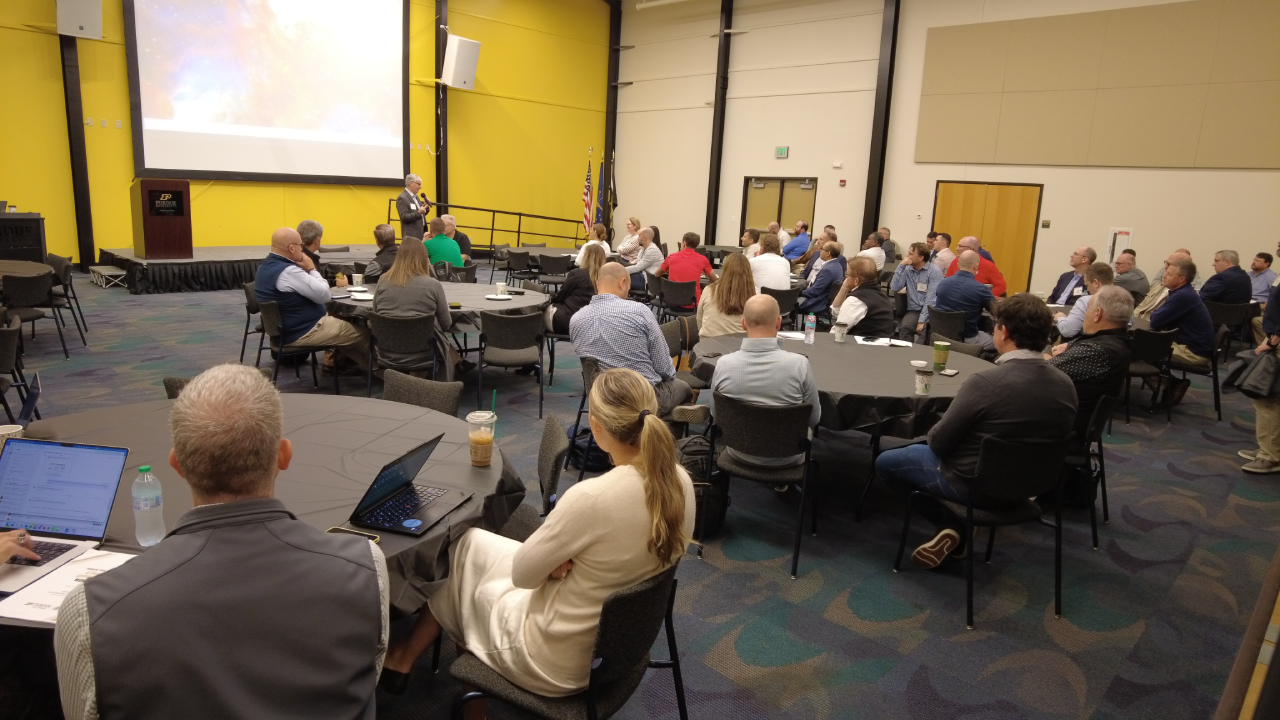
Over the past several months, our Innovation Fellows traveled across five states and conducted dozens of interviews throughout the agrifood value chain. We narrowed that work to eight Strategic Opportunity Areas and brought them to Purdue for this Workshop, where producers, processors, agribusiness executives, investors, and technology leaders helped us pressure-test them.
We did not ask the people in those rooms to validate our thinking. We asked them to show us where we were wrong. Across 32 breakout sessions, we captured and analyzed 1,405 contributions. Seven insights stood out.
1. A real problem is not the same thing as a business.
Only 2% of the skeptical comments questioned whether the underlying problem was real. Instead, 38% focused on adoption, trust, and behavior; 37% challenged whether the proposed solution could beat existing alternatives and workarounds; and 24% questioned willingness to pay.
That distinction matters. Agrifood has plenty of consequential problems. Finding them is only the beginning. The harder work is determining whether solving one creates enough value, whether a new solution can overcome the way the job gets done today, and whether someone will actually pay for the improvement.
A real problem is necessary. It is not sufficient.
2. Behavior change may be harder than technology change.
Adoption, trust, and behavior appeared in 22% of everything we heard.
In one discussion, participants described customers who had already been shown the economics of making a change. The information was available. The financial case had been made. Yet, as one participant put it, “They still don’t make a change.”
That should matter to anyone building technology for agriculture, particularly as AI makes it easier and faster to create new capabilities.
We often assume that better information produces better decisions. It does not always work that way. People rely on experience, relationships, habits, and trusted advisors. They may understand the economics and still choose not to act.
The best technology does not win if it requires customers to behave in ways they will not.
3. The data often exists. The value does not—yet.
One participant described the process of understanding the financial position of a farm operation. The information existed, but it was spread across QuickBooks, Excel files, and seven different business entities. Someone had to manually bring it together before it could inform a decision.
The problem was not a lack of data. It was converting fragmented data into something useful at the moment it mattered.
We heard variations of this throughout our discovery work. Agrifood businesses are generating enormous amounts of information, but more information does not automatically create more value.
This is where I believe some of the most interesting AI opportunities may emerge. Agrifood may not need another dashboard or another report. It needs better ways to turn the data it already generates into decisions.
The opportunity is not more information. It is a better call, made with greater confidence.
4. The user, the customer, and the payer may be three different people.
Again and again, people in the rooms pointed our Fellows toward someone other than the customer we originally imagined. Depending on the opportunity, they suggested lenders, dealers, advisors, brokers, reinsurers, and others who might capture more of the economic value from solving the problem.
One participant cut through a discussion with a simple question: “Who pays for the solution?” It is a question every entrepreneur should be able to answer.
The person experiencing the problem may not be the person with the greatest incentive to solve it. The person using a product may not control the budget. And the organization paying for a solution may capture value somewhere entirely different in the system.
Do not stop at asking, “Who has the problem?” Ask, “Who benefits enough from solving it to pay?”
5. Your biggest competitor may be Excel—or someone the customer already trusts.
Existing solutions and workarounds were the most frequently discussed topic across the entire workshop, appearing in 24% of all contributions.
Participants pointed to spreadsheets, QuickBooks, CPAs, dealers, consultants, advisors, and existing software. In one discussion, an operator described the current job as simply “too easy to do in Excel.” That is an important reminder for anyone building in agrifood.
Your competition is not necessarily another startup. It may be a spreadsheet that is good enough. It may be the dealer who has served the operation for 20 years. It may be the CPA sitting across the kitchen table. It may simply be the way the customer has always done the job.
Technology does not have to be better than another technology. It has to be materially better than the customer's current alternative—and better enough to justify changing.
6. Don’t digitize everything. Find the decision that matters.
Several of the broad opportunities we brought into the workshop became much more interesting when the discussion narrowed them to a specific decision or recurring trigger.
Should I replace this machine or keep it another year? Can I make this capital commitment without putting liquidity at risk? Which animal needs attention first? Where exactly are we losing yield?
In one discussion, participants questioned whether a farmer would subscribe to software for a decision that might occur only once a year. It was a fair challenge. A painful problem is not automatically a good software business; frequency matters, urgency matters, economics matter.
Before the workshop, one of my working hypotheses was: Do not try to fix the system. Fix the thing. The conversations pushed that idea one step further. Do not digitize everything. Find the consequential moment when someone needs to make a better decision.
That may be where technology—and increasingly AI—earns its place.
7. Disagreement is valuable—if you invite it early enough.
This may be my biggest takeaway. We deliberately looked for counter-evidence in those 1,405 contributions. We wanted to know where people disagreed with us, which assumptions did not hold, and what we were missing. Constructive skepticism is cheap before you build the company. It becomes expensive afterward.
In one breakout room, an opportunity entered the discussion built around one customer. By the end of the session, the people around the table had identified a different customer with a stronger reason to pay and a different way to deliver the value.
Same pain. Different customer. Different job. Potentially, a very different business.
That is the value of putting the agrifood value chain in the room before the company exists rather than after.
The goal was never to prove that our eight opportunities were right. It was to discover where we were wrong before we started building.
Now We Build
Four opportunities have advanced from the workshop. Our Innovation Fellows are now developing prototypes, putting them in front of prospective customers, and continuing to test the customer, economics, workflow, adoption, and business model. On December 11, they will pitch the startup companies that emerge from that work.
This is the part of the DIAL Ventures model that matters most to me. Industry problems come in as hypotheses. We gather evidence. Practitioners challenge the assumptions. The evidence reshapes the customer, economics, and solution. Only then do the strongest opportunities become companies.
Industry problem → evidence → challenge → refinement → solution → company
We do not start with technology and look for somewhere to apply it. We start with the agrifood system, find consequential problems, and try to kill our assumptions before we build companies around them.
This studio happens to be building AI-first companies. But the order matters.
Problem first. Then AI-first.
And perhaps most importantly, we are building the next generation of agrifood companies with the industry, not for it.
If you work anywhere across the agrifood value chain and see one of these dynamics differently, I would like to hear from you. The disagreement may be the most valuable part.